


Conducting group interviews requires skill and planning.
You're dealing with a group of individuals, each with unique personalities and communication styles. Unlike other types of interviews, this format gives you the challenge of identifying a standout candidate among many.
Group interviews resemble a reality TV show without the drama. They offer a firsthand view of how potential hires act in team settings, solve problems on the fly, and handle pressure. It's as much about their actions as their words.
So, what distinct advantages do group interviews bring to the table?
Firstly, they level the playing field. Shy candidates have a platform to excel, while overconfident ones may show their true colours.Â
Moreover, this format highlights those who can enhance team dynamics and showcases candidates with superb soft skills who can lead effectively and collaborate seamlessly.
Feeling anxious? Don't be; with strategic planning and insightful questions, you can transform this process into a highly effective recruitment tool.
Let's delve into strategies that will enable you to find the best new talent for your organisation.
TL;DR
- Group interviews evaluate multiple candidates at once, emphasising teamwork and leadership.
- They expose true personalities and highlight key soft skills.
- Pros include swift hiring, ample discussion, and showcasing communication prowess.
- Cons involve intense competition, potential dominance by some, and limited question depth.
- Successful group interview tips: diligent research, active listening, confident interaction.
- Frequent questions address teamwork, conflict management, task prioritisation, and cultural fit.
- iSmartRecruit software refines group interviews via real-time collaboration and advanced analytics.
What is a Group Interview?
A group interview involves interviewing several candidates simultaneously for a job. This method enables employers to assess candidates' skills, experience, and fit more efficiently, especially when multiple roles need filling quickly.
Group interviews measure how candidates interact in a team, communicate, and display leadership and problem-solving abilities.
Employers observe candidate interactions, providing insights into their personalities, attitudes, and work styles.
Confused about group interviews versus panel interviews? The following section clarifies these differences.
Difference between Group Interview & Panel Interview
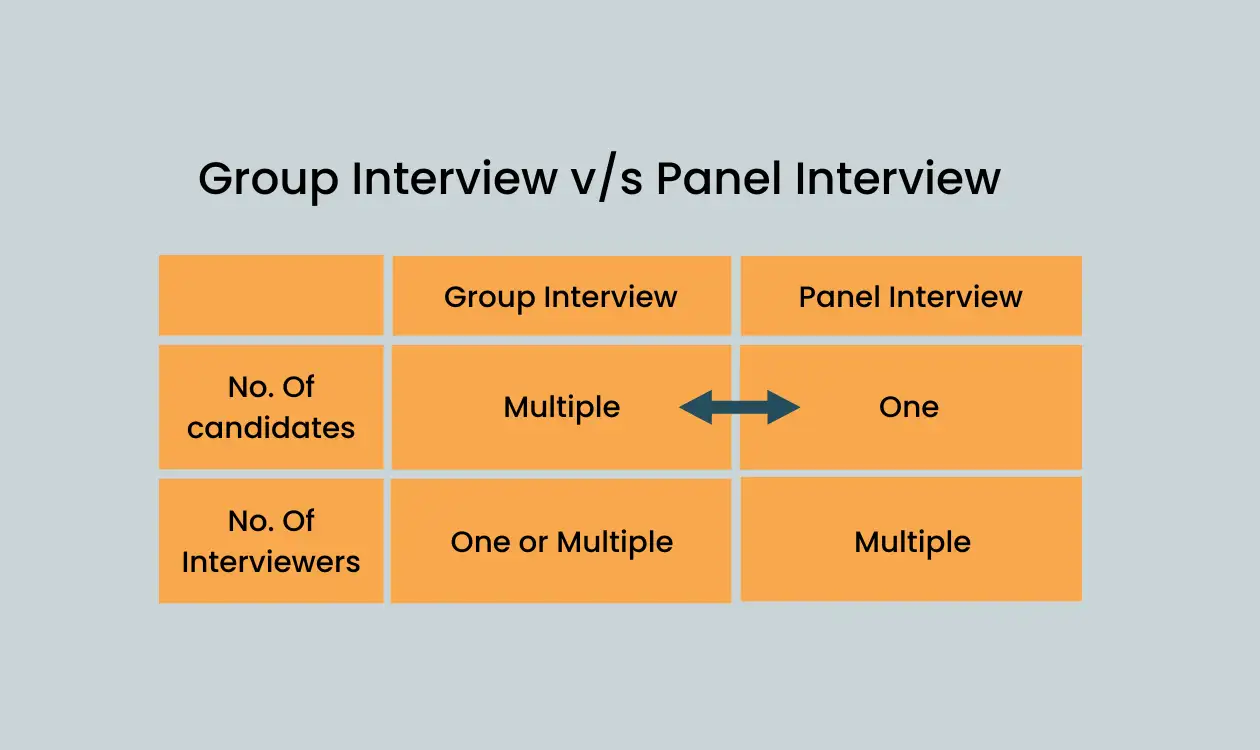
For hiring candidates, recruiters often opt for either group or panel interviews. Although both have advantages and drawbacks, their core differences significantly affect the hiring process.
Let's examine these differences and determine which method suits your organisation best.
Group Interview
- Involves one or more interviewers conducting interviews with several candidates simultaneously.
- All candidates typically answer the same set of questions.
- May feature group activities or discussions.
- Offers an efficient way to assess multiple candidates for various roles.
- Less structured than panel interviews, which may hinder objective candidate comparison.
Panel Interview
- A panel of interviewers questions one candidate at a time.
- Interviewers may specialise in different areas and tailor questions accordingly.
- Focuses on individual candidate responses.
- Enables more thorough evaluation of each candidate.
- Potentially intimidating due to the presence of multiple interviewers.
Let’s explore the pros and cons of the Group Interview Process.
Group Interview Advantages and Disadvantages
Group interviews offer fresh perspectives for employers and candidates alike. While they provide an engaging way to conduct interviews, they also pose challenges. Explore the advantages and disadvantages of group interviews below.
Advantages of Group Interview
Companies and organisations favour group interviews for several reasons, mainly due to the benefits they offer over one-to-one interviews. Here are some key advantages:
1. Quick selection
Both recruiters and candidates can benefit from efficient evaluation, allowing for fast decision-making and saving time.
2. Scope for discussion
Candidates get to express opinions, potentially influencing recruiters and revealing personal traits and attitudes.
3. Diverse responses
The format offers varying answers to similar questions, aiding in understanding candidate mindsets.
4. Identify top candidates
Group interviews illuminate potential standout candidates and showcase their team-working skills.
5. Demonstrate communication skills
Candidates have a platform to illustrate effective communication, a critical job skill.
6. Immediate decisions
Decisions can often be made on the spot, potentially removing the need for further review.
Disadvantages of a Group Interview
Despite their efficiency, group interviews have their limitations. Below are some of the challenges:
1. Intense competition
Competitive environments can lead to decision-making struggles for recruiters and candidates alike.
2. Dominating discussions
Some candidates may monopolise discussions, impacting fair evaluation.
3. Overpowering participants
Dominant candidates may overshadow quieter ones, making holistic assessment difficult.
4. Limited questioning
Time constraints can restrict follow-up questions, potentially affecting candidate evaluation.
5. Conflicting mindsets
Conflicts between strong candidates can be challenging for recruiters to manage.
Group Interview Tips For Succeeding
Succeeding in any interview, be it group, panel, or simple one-to-one, requires strategy. Group interviews call for specialised strategies, so here are focused tips for thriving in them.
Consider these essential tips for group job interviews:
- Research current industry trends and stay updated.
- Show respect and greet everyone involved.
- Prepare an engaging self-introduction.
- Pay careful attention to peer answers before responding.
- Don't shy away from contributing during discussions.
- Encourage contributions from fellow candidates.
- Ask insightful questions to explore topics thoroughly.
- Confidence is your ally, wear it well.
- Maintain eye contact to convey engagement. Sample Group Interview Questions and Answers

Common Questions and Answers for a Group Interview
Here are some questions that can guide your preparation for a group interview.Â
Q1. Can you tell us about a time when you had to work in a team to achieve a goal?Â
Ans. Absolutely. In my previous job, I was part of a team that had to develop a new product within a tight deadline. We had to work closely together, dividing tasks and communicating effectively to ensure we met our goals. Through this experience, I learned the importance of clear communication and collaboration.Â
Q2. How do you handle conflicts within a team?Â
Ans. Conflicts are natural in team dynamics, and addressing them directly is crucial. Staying calm, considering all viewpoints, and finding mutually agreeable solutions is my approach. I aim for open-mindedness and a collaborative spirit.Â
Q3. How do you prioritise tasks when working in a team?Â
Ans. When working in a team, it's important to prioritise tasks based on their level of importance and urgency. I always try to communicate with my team members to ensure we're all on the same page and working towards the same goals. By staying organised and focused, we can ensure that we're making progress on all of our tasks.Â
Q4. How do you contribute to a positive team culture?Â
Ans. A positive team culture boosts success, so I aim to be supportive, proactively offering help, and jointly celebrating achievements. I advocate for open communication, ensuring everyone's ideas and feedback are heard, fostering productivity.
How iSmartRecruit Will Help You In Group Interviews
Having read through this guide, you're equipped with the pros and cons alongside impactful questions to use in interviews.
One unparalleled advantage left to mention is how iSmartRecruit’s Recruitment Software can elevate your group interviews.
With real-time collaboration, you can gather interviewer feedback swiftly, presenting a comprehensive evaluation platform.
Advanced analytics provide data-driven insights for faster decision-making. iSmartRecruit not only saves time but also boosts the quality of hiring decisions, transforming interviews into a strategic advantage.
Why wait? Clear all uncertainties now with a free demo to witness the iSmartRecruit difference in group interviews.
1.png)
Frequently Asked Questions - FAQ
1. What is a group interview?
A group interview is a hiring method where multiple candidates are interviewed at the same time. Employers assess communication, teamwork, leadership, and problem-solving skills by observing how candidates interact in a group setting.
2. How does a group interview work?
In a group interview, candidates participate in discussions, activities, or problem-solving tasks together. Interviewers evaluate how each person communicates, collaborates, and handles competition or pressure.
3. What is the difference between a group interview and a panel interview?
A group interview involves multiple candidates interviewed simultaneously. A panel interview involves one candidate being interviewed by multiple interviewers at the same time.
4. How should you prepare for a group interview?
To prepare for a group interview, research the company, practice a strong introduction, stay confident, listen actively, contribute thoughtfully, and demonstrate teamwork and leadership skills.
5. What are common group interview questions?
Common group interview questions focus on teamwork, conflict resolution, leadership, prioritisation, and communication. Employers often ask candidates to share real examples of working in teams or solving challenges.
About the Author

Join our email subscribers &
get great blogs like this
periodically.


